

Fixed Income: A natural diversification tool
Joseph Morgart 25-Sep-2026

For many investors, adding strategies with returns that have low or no correlation to other major asset classes is at the top of their wish list. This is the very essence of diversification, and it largely explains the alure of some alternative investments.
Also, on the wish list for many is securing a new source of income that has the potential to deliver attractive risk-adjusted returns regardless of what’s happening in the broader economy and irrespective of the Federal Reserve’s policy moves.
We think that catastrophe bonds (cat bonds), a subset of insurance-linked securities, have the potential to check both the above boxes. Let’s take a closer look at this unique and nuanced area of the fixed income world.
A Time-Tested Concept
Not all investors are familiar with cat bonds, so they may be surprised to know that they have been around for years. Cat bonds can be defined as high-yield risk transfer instruments that offer investors a chance to participate in the reinsurance industry, which has existed for more than 150 years. In effect, cat bonds were created to allow insurers to transfer some of the risks associated with major natural disasters, such as hurricanes, wildfires or major earthquakes. In return, investors have an opportunity to capture potentially attractive returns.
Of course, we all know that there is no free lunch. Higher potential returns come with higher risk, and investors can lose principal in cat bonds if a predetermined catastrophic event—often called a triggering event—occurs during a cat bond's risk period (typically one year). However, history has demonstrated that investors who deployed this as a strategic allocation (as opposed to trading in and out) have not suffered sustained principal losses. (See Rolling three-year returns table below.) The insurance industry has demonstrated the ability to reprice risk efficiently (i.e., raise premiums), particularly after a catastrophic event. Thus, we think that the true risk profile of cat bonds is one of the misunderstood aspects of this fixed income asset class.
Industry data substantiates this point. The most widely used cat bond benchmark—the Swiss Re Global Cat Bond Index—has delivered positive performance in 18 of the past 19 years (its inception). In fact, cat bonds, as represented by the Swiss Re Global Cat Bond Index, have offered more attractive risk/return characteristics than many more well-known asset classes over the past decade. Please see Index returns below.
Using the return history of Swiss Re Global Cat Bond Index (2007-2025) as a proxy for the asset class, we evaluated its three-year annualized rolling returns since inception. The range of outcomes were from 2.58% to 16.07%. In 100% (17 of 17) of the rolling three-year periods, the index achieved absolute positive returns, and in all rolling three periods, the returns were in excess of 2%. Of course, past performance does not guarantee future results.

Marching to Their Own Beat
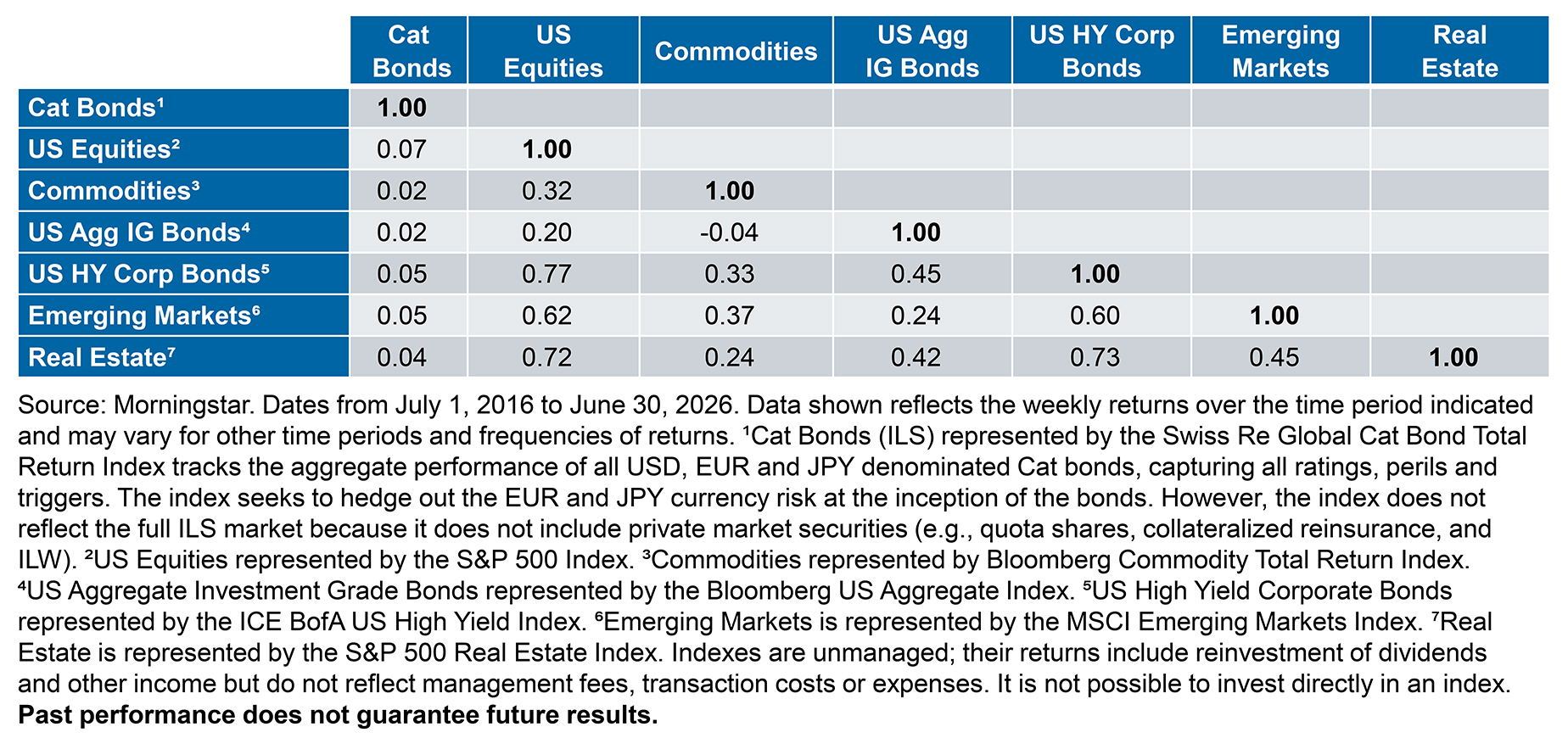
Although financial markets are typically focused on things like inflation data, the yield curve, corporate earnings, tariffs, geopolitics and GDP projections, cat bond investors can be less concerned by these conventional economic metrics. Cat bonds are largely uninfluenced by such factors, and thus they have low correlation to other broad (and far more popular) asset classes. This is a key benefit for investors, and it may be of particular interest today. After all, traditional fixed income can be a ballast for equities in a broader investment portfolio, but what can be a ballast to traditional bonds if rates continue to rise?
The below table shows the correlation of the Swiss Re Global Cat Bond Index (as a proxy for the cat bond sector) to other asset classes during the past 10 years. It is important to point that because cat bonds are tradable assets, broader capital market supply and demand dynamics may increase their correlation to other financial assets to some degree, though their ability to perform irrespective of many traditional economic factors is undisputed.
Implementation Flexibility
As with any investment, there are always risks, and due diligence remains imperative when selecting a cat bond strategy. A cat bond investment could suffer principal losses upon the occurrence of one or more natural disasters that trigger losses of a certain magnitude. Thus, cat bonds may not be suitable for every investor’s portfolio. However, an actively managed cat bond portfolio is designed to balance geographic exposures, while also exploiting possible structural inefficiencies in the market.
In the end, we believe that a cat bond allocation may be well positioned to help solve for several investor objectives. The sources of risk, return, and liquidity are unlike anything in a traditional diversified investment portfolio, and the portfolio implementation flexibility could make them viable for either an investor’s fixed income allocation or an alternative investment bucket.
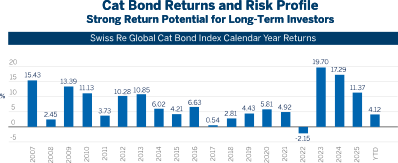
Source: Swiss Re Global CAT Bond Index as of June 30, 2026. Past performance does not guarantee future results. Not meant to represent performance of any Pioneer Investments portfolio. The Swiss Re Global Cat Bond Index tracks the aggregate performance of all USD, EUR and JPY denominated Cat bonds, capturing all ratings, perils and triggers. The index seeks to hedge out the EUR and JPY currency risk at the inception of the bonds. However, the index does not reflect the full ILS market.
Terms and Definitions
- Catastrophe bonds: High-yield debt instruments designed to raise money for insurance companies in the event that specific natural disasters, such as earthquakes or tornados, occur.
- Correlation: Measures the degree to which assets or asset class prices have moved in relation to one another. A correlation of -1 means prices moved in opposite directions; 1 means prices moved in lockstep; and 0 implies no relationship among prices.
- Reinsurance: The insurance that an insurance company purchases from another insurance company or investor to insulate itself from the risk of a major claims event.